
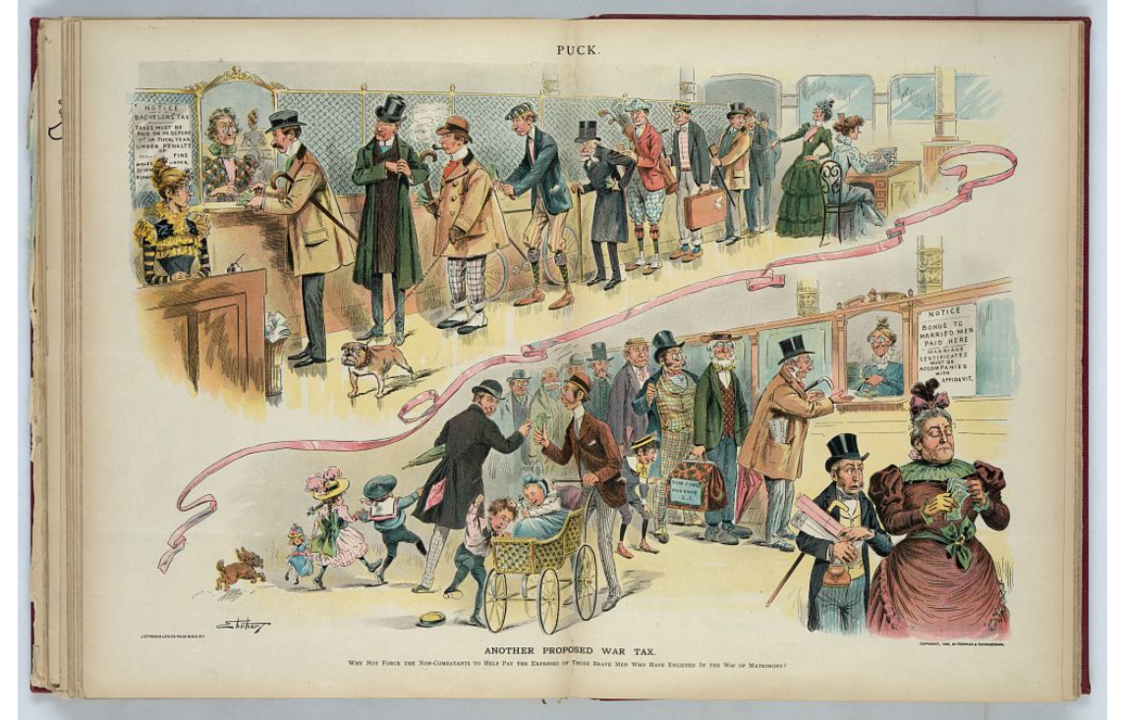
A bachelor tax is a punitive tax typically imposed on unmarried men. In the modern era, many countries do vary tax rates by marital status, so current references to bachelor taxes are typically implicit rather than explicit.
Such explicit measures historically would be instituted as part of a moral panic or homophobia due to the important status given to marriage at various times and places (as in Ancient Rome, or in various U.S. state legislatures during the early 20th century).
Frequently, this would be attached to racial (e.g., as part of Apartheid policies) or nationalistic reasons (as in Fascist Italy or Nazi Germany).
More recently, bachelor taxes were viewed as part of a general tax on childlessness, which were used frequently by member states of the Warsaw Pact.
Bachelor Tax
| Location | Date(s) | Passed | Comment |
|---|---|---|---|
| Ancient Rome | 9 AD | Yes | Main article: Lex Papia Poppaea § Promotion of MarriageSee also: Aes uxorium The Lex Papia Poppaea was introduced by Roman Emperor Augustus to encourage marriage. In particular, penalties were imposed on those who were celibate, with an exception granted to Vestal Virgins (Ulp. Frag. xvii.1). The law also imposed penalties on married persons who had no children (qui liberos non habent, Gaius, ii.111) from the age of twenty-five to sixty in a man, and from the age of twenty to fifty in a woman. (Tacit. Ann. xv.19). |
| Argentina | 1939 | No | Senator Alfredo Palacios proposed a law that would create a special fund that would give benefits to government employees for each child under 16 that they had. The same law also prescribed that said employees would be prioritized for promotions at work. To finance this fund all single people and childless couples would have to give up a day's worth of their salary that would be transferred to the fund. |
| Bulgaria | 1925, 1943, 1968 | Yes | Measures to try to introduce a bachelor tax in Bulgaria first began in 1917, where it often took on a pro-eugenic character and part of discussion amongst Bulgarian Fascist party officials. It was formally proposed by 1925, only formally introduced in 1943, but passed only in 1968 only after applying it to both sexes. |
| England | 1798 | Yes | An income tax was passed particularly discriminating against bachelors |
| Finland | 1935 | Yes | Main article: fi:Vanhanpojan ja vanhanpiian vero Increased tax burden for unmarried, childless citizens over the age of 24 from 1935 to 1975. |
| France | 1913 | No | Proposed not only a large tax on bachelors, but also "spinsters." |
| France | 1939 | No | Meant as a proposal to match similar proposals in Fascist Italy and Nazi Germany. |
| German Empire, Reichenburg | 1915 | Yes | As part of a progressive taxation measure. |
| Italy, Vastiogirardi | 1999 | No | The mayor of Vastogirardi, Italy proposed to reinstitute a bachelor tax locally. |
| Kingdom of England | 1695 | Yes | Main article: Marriage Duty Act 1695 The English Parliament passed the Marriage Duty Act 1695, also known as the Registration Tax, which imposed a tax on births, marriages, burials, childless widowers, and bachelors over the age of 25. It was primarily used as a revenue raising mechanism for war on France and as a means of ensuring that proper records were kept by Anglican church officials. The tax was found ineffective and abolished by 1706. |
| Kingdom of Italy | 1927 | Yes | Levied in Fascist Italy from 1927 until the fall of Mussolini in 1943, the Italian bachelor tax targeted unmarried men as part of a race-based pronatalist policy. By 1936, Italian bachelors paid nearly double their normal income tax rate. |
| Kingdom of Spain | 1928 | Yes | Law passed following in the footsteps of Italy, the Kingdom of Spain also passed a bachelor tax, only with very few exceptions, including Roman Catholic priests as well. |
| Nazi Germany | 1934 | Yes | Main article: Ehestandshilfe Law passed following in the footsteps of Italy and Spain, but mainly for Nazi "family values". In particular, it was meant as part of Hitler's "three Ks" (Kirche, Küche, Kinder: "Church, Kitchen, Children") national-conservative pronatalist policy to get German women "back into the home". |
| Nevers, France | 1223 | Yes | Charged a yearly tithe of five solidi to any bachelor as part of a moral panic. |
| Ottoman Empire | 15th century | Yes | Main article: Resm-i mücerred Resm-i mücerred was a bachelor tax instituted in the Ottoman Empire in conjunction with the resm-i çift (land-owning Muslims) and the resm-i bennâk (landless peasants). Those who fell under the tax were more likely to migrate to other areas. Migrant mücerred were more likely to make their way to a growing town. |
| Poland | 1946 | Yes | Introduced Bykowe, which was a tax on childlessness that included a tax on those unmarried above 21 years from January 1, 1946 to November 29, 1956. It was later extended to those over 25 years of age until January 1, 1973 when it was repealed. |
| Romania | 1986 | Yes | Some time after the population increase from the decreţei 770 generation, a celibacy tax was instituted. The law continued to be enforced until the Romanian Revolution of 1989. |
| South Africa | 1919 | Yes | Imposed a bachelor tax for racial reasons in order to match the white population growth with the black one. |
| Soviet Union | 1941 | Yes | A childlessness tax was enforced in the USSR from 1941 to 1992; it was applied to childless men from 25 to 50 years of age and to childless women from 20 to 45 years of age. The tax was income based, taking 6% of the childless person's wages. |
| Turkey | 1949 | Yes | Suggested and passed as a wealth transfer between bachelors to families. |
| United States, California | 1934 | No | As a response to the low 1933 birth rate in California, Director of Finance Rolland Vandegrift proposed a $5 to $25 bachelor tax, but the measure did not succeed due to economic considerations of the time. |
| United States, Connecticut | 1857 | No | The Connecticut legislature repealed a motion to implement a bachelor tax in the state, under the argument that different methods of taxation already taxed bachelors more heavily. |
| United States, Delaware | 1907 | No | Started as a joke before generating much discussion and ultimately being defeated. |
| United States, Georgia | 1911 | No | One assemblyman proposed a $50 yearly tax on bachelors, proposing that the funds should go to schools. |
| United States, Michigan | 1837, 1848, 1849, 1850, 1897, 1901, 1911, 1919, 1935 | No | Michigan had made repeated attempts to instantiate a bachelor tax. In 1837, state senator Edward D. Ellis attempted to pass such a bill, but the measure failed. In 1848, a petition made it to a House committee, but did not reach the floor. In 1849, another proposal was made in a House committee that did not reach the floor. Again in 1850, another petition reached the House, but did not find a sponsor. During the Civil War it was proposed again, this time as a revenue measure as opposed to a public welfare measure, but again failed to reach the floor. It was then repeatedly brought up in 1897, 1901, 1911, 1919, with the first resulting in counter proposals for a similar tax to be applied to women who reject marriage proposals and the final resulting in arguments that bachelors had a statistically higher rate of delinquency as opposed to other groups. The final proposed bill that also made the floor of the Michigan Congress was in 1935 before it too failed due to economic considerations of the time. |
| United States, Minnesota | 1911 | No | Proposed a $5 yearly levy on bachelors. |
| United States, Missouri | 1821 | Yes | Missouri applied a $1 tax on all unmarried men. By the following year, it was replaced by a poll tax. |
| United States, Montana | 1921 | Yes | Applied a $3 tax on all bachelors in the state. One of them, William Atzinger, refused to pay on sex discrimination grounds. On January 11, 1922, the state supreme court struck down the “bachelor tax” and another poll tax applicable only to men. However, it was done on the grounds that the Montanan constitution of 1889 did not grant the legislature the power to tax individual persons; and attempts to define it as a policing measure for matters of public health as opposed to a revenue measure were found invalid (and the decision did not reference Atzinger's arguments against the tax on grounds of sex discrimination). |
| United States, New Jersey | 1898-02-12 | No | Assemblyman Waller of the New Jersey State Legislature proposed a bachelor tax as a sumptuary tax; however, the bill was not passed. |
| United States, New York | 1825 | No | A bill was proposed in the New York legislature comparing bachelors with dogs, aiming to replace the then current tax on dogs with one on bachelors instead. |
| United States, Wisconsin | 1921 | No | Generated frequent moral debate at the time. |
| United States, Wyoming | 1890 | No | Briefly considered a $2.50 bachelor tax in 1890, but the motion was tabled. |
| Weimar Germany, Repelen | 1923 | Yes | Weimar Germany passed a bachelor tax of 2000 marks per month. However, this law was quickly overturned by federal authorities. |
